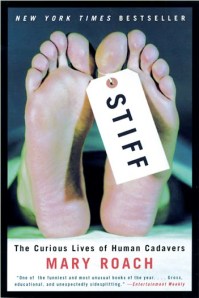
Stiff by Mary Roach
If you’re anything like me, you watch those formulaic detective shows. You know, the ones where everything is packaged in a neat bow at the end – usually with the help of a medical examiner who knows the exact time and date the victim was murdered. And if you’re any more like me (which, creeeepy!), you’ve wondered at the accuracy of that time and date. I mean, is it even possible to know stuff like that?
Apparently, it is.
In one of the disturbingly engaging chapters in Mary Roach’s Stiff: The Curious Lives of Human Cadavers, she describes a section of the University of Tennessee’s campus devoted to the study of decomposing bodies in various states of…disposal? Eek, that sounds a little indelicate. But get this: some are splayed naked under trees while others are dressed to the nines but stuffed in a car’s trunk. Still others are in shallow graves or dumped in marshy lake water. All of this is done under the scientific eyes of Professors and soon-to-be medical examiners to determine the rate at which the human body decays in various circumstances. E. GADS. Let me warn you right now: if you are at all queasy about this subject matter, for the love of all that is good and holy, do not do an image search of the University of Tennessee body farm. What is seen cannot be unseen.


 On the night of her 30th birthday, Rachel allows herself to sleep with the man she has desired all throughout law school. And it was great. Dexter Thatcher is great, the sex was great, and she feels great. That is until she wakes the following morning with a slight hangover and her absolute best friend’s fiancé in her bed. That’s right, folks. Dex is none other than Darcy’s long time boyfriend and recent fiancé. In fact, Rachel was the one who introduced the two. Bitch, right?
 Booksellers Without Borders
 bookiegalore
 Recidivist Reader
 hardboundandgagged
 ipsedixit
 turpentinestevens
 überliterate
 Booksellers Without Borders