RSS

Author Archives: Recidivist Reader

Water for Elephants by Sara Gruen

Water for Elephants

Water for Elephants by Sara Gruen

This is one of those books that customers have been recommending to me for years, but I’ve been never felt much of an urge to read myself.  With the movie coming out I figured I would give it a shot, not that I have any particular plans to see the movie, but just to see what all the fuss is about.

We’ll start with the good: Gruen obviously did a lot of research on Depression-era train circuses. She does a good job describing what life on tour with working men, performers, sideshow freaks, and a menagerie of animals might be like.  It’s a very quick, easy read (I read it in two sittings) that moves along at a decent clip.

Some problems I had:

1) Jacob, the protagonist, is debilitatingly passive throughout the story.  He constantly finds himself in circumstances where others take control from him, and he does nothing to stop them.  Other characters make almost all his decisions for him, which is frustrating beyond belief.  For instance, he makes a vow to himself not to let any of the animals be harmed again – but then stands idly by as the elephant is tortured with a hook.  Multiple times.

Read the rest of this entry »


Tags: , , , , ,

Firmin by Sam Savage

Firmin by Sam SavageI bought this book because it had a giant bite taken out of it, and it said it was about a rat who grew up in the basement of a bookstore.  What’s not to like?  (Well, okay, I kind of have a rat phobia, but I was willing to give it a try.)
Firmin is born in a nest made of a shredded copy of Finnegan’s Wake, in the basement of a 1960s-era Boston used bookstore.  He’s the runt of the litter and often gets shorted at feeding time.  As a result, he turns to the books surrounding him for something to chew on and finds that he can’t stop.

Like many things that start as small, illicit pleasures, paper chewing soon became an imperative, and then an addiction, a mortal hunger whose satisfaction was so delightful that I would often hesitate to pounce on the first free tit. (17)

In this way, Firmin becomes a literal consumer of literature.  After a while, however, he learns to read what is written on the pages, and switches to only chewing on the margins.  Soon he is better read than most humans, and he migrates to the ceiling where he watches the bookstore below.  I love his description of what he observes, because it reminds me of the joy inherent in having a bricks-and-mortar bookstore to visit:

Read the rest of this entry »


Tags: , , , ,

The Grimm Legacy by Polly Shulman

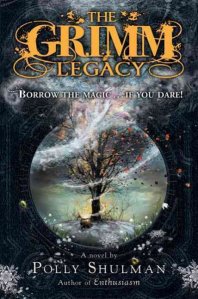
The Grimm Legacy

The Grimm Legacy by Polly Shulman

The Grimm Legacy begins as a tale of an ordinary life: Elizabeth Rew is adjusting to her mother’s death, her father’s remarriage, and switching to public school so her father can help pay tuition for her two new stepsisters.  She has nobody to sit with at lunch time and feels lonely and virtually invisible.  After writing her term paper on the Grimm brothers, her friendly (if eccentric) history teacher offers her an after school job, which she accepts gratefully.

Elizabeth soon learns, however, that this is no ordinary job.  She has been hired as a page at the New-York Circulating Material Repository, a sort of library for objects.  The repository stores and lends out everything from china tea sets to Marie Antoinette’s wig.  But what really surprises our fair heroine is when she learns that the basement of the repository houses the Grimm Collection – magical objects bequeathed to the repository straight out of fairy tales and folklore.

I love this premise for a young adult title, because not only does it make the mundane magical (how many high school students wish their after school job was a bit more glamorous?), it also takes the enchanted and makes it ordinary.  Though apprehensive of these items at first, by the end of the book all the young repository pages have used magical objects in their everyday lives, with varying degrees of success and many unforeseen consequences.

Read the rest of this entry »


Tags: , , , , , , , ,

Of Things Lost and Found

The Book of Lost Things

The Book of Lost Things by John Connolly

My colleague and partner in crime posted some of her favorite books this evening, including The Book of Lost Things by John Connolly.  Since this is one of my all-time favorite books, too, I thought I should elaborate.

A short synopsis, first: David, a young boy growing up in London during WWII, loses his mother and turns to books of fairy tales and mythology for solace.  He soon begins hearing the books whispering to him and catches glimpses of things which don’t belong in his world.  He is eventually transported to a world woven from these stories – but never in quite the way you would expect.

On the surface, this book could be unremarkable.  It’s been done before, many times, this coming of age tale in a fantasy world.  The Book of Lost Things, however, has enough unique and imaginative characters and plot twists to make revisiting the form more than worthwhile.  It is all around well-conceived, well-structured, and well-written.  My kind of book!

In the end, all you really need to know about the book is this: I made the mistake of starting to read it during lunch one day.  My copy still has a large stain on page 6, by which point I was so engrossed that I missed my mouth and dropped a piece of pineapple on it.  If you haven’t had the pleasure yet, drop what you are doing (or eating) and get yourself a copy.  You can thank me later.


Tags: , , , , , , ,

The Beauty in Every Inch

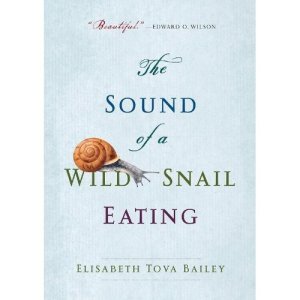
The Sound of a Wild Snail Eating

The Sound of a Wild Snail Eating

The Sound of a Wild Snail Eating

by Elisabeth Tova Bailey

Most of us are too busy to spend a year watching a snail go about its business.  We might equate such activities with watching the grass grow or paint dry.  How fascinating could the daily exploits of a gastropod possibly be, after all?

Elisabeth Tova Bailey, however, found herself with little else to do.  Bedridden due to a mysterious autonomic ailment, Bailey found herself unable to even sit up or turn over without a major effort.  A friend visited her one day, bringing a pot of field violets from the nearby woods – and, as a bonus, a woodland snail.

With literally nothing else to do or watch, Bailey began to notice the habits of her new companion.  From its eating and sleeping habits to its methods of locomotion, her observations began to open a window into her tiny companion’s world.

Read the rest of this entry »


Tags: , , ,